
Airtightness Test & Diagnostic (Blower Door)
Air leakage control is the single most important retrofit activity, and it should be considered first in any upgrade strategy for your house. Air leakage control is essential. Every time you insulate, install or upgrade the air barrier system, ensure that moisture does not enter the insulation or building envelope. Comprehensive air leakage control is the systematic identification and sealing of as many air leakage paths as possible with weatherstripping and caulking and by applying gaskets and tapes. Did you know that your windows, doors, cracks in the walls, interior trim and even light fixtures in the ceiling are potential leakages areas?
Understanding Blower Door Tests
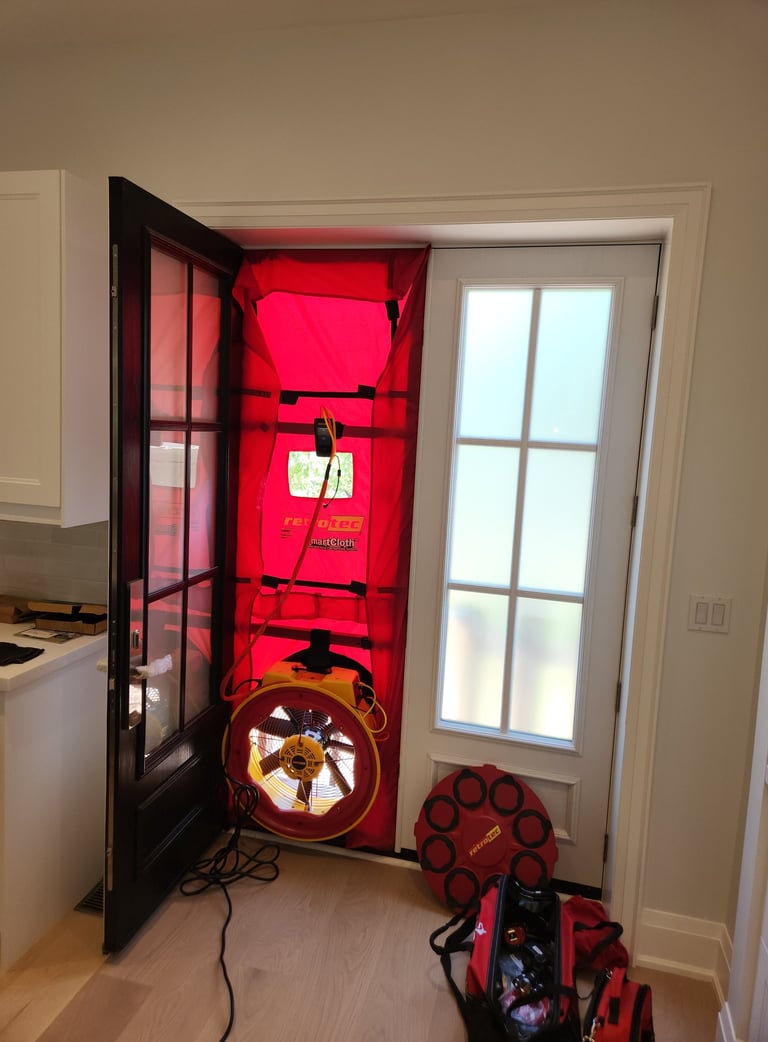
A blower door test is a key diagnostic tool in residential energy audits, performed by NRCan-certified energy advisors at EnerSolution Inc. The test measures your home’s air leakage, identifies airflow gaps, and ensures your building envelope is properly sealed for optimal energy efficiency.
A trained energy professional temporarily installs a blower door—a frame and fan system—into an exterior doorway. The fan depressurizes your home, allowing outside air to flow through unsealed gaps, cracks, and penetrations. Using advanced tools such as infrared thermography and smoke pencils, our experts pinpoint areas of air leakage and insulation deficiencies.
How It Works
Calibrated Blower Doors: Accurately measure the home’s airtightness and quantify air leakage before and after air-sealing.
Air Sealing & Diagnostics: Combined with blower door assisted air sealing, we reduce drafts, improve indoor comfort, and lower heating and cooling costs.
Data Analysis: Airflow readings are recorded digitally to evaluate the air infiltration rate, ensuring measurable energy improvements.
Preparing for Your Test
To ensure accurate results:
Walk through your home with our energy advisor, highlighting drafty areas.
Provide access to all rooms, attics, crawlspaces, and built-in cabinets.
Close exterior doors and windows; open interior doors; close fireplace dampers.
Ensure wood-burning appliances are completely out and controls on fossil fuel appliances are set safely.
Testing typically takes 1–2 hours depending on home size and complexity.
Why Airtightness Testing Matters
A blower door test is essential for:
Reducing energy consumption and utility costs
Improving indoor air quality and overall comfort
Supporting eligibility for home energy rebates and incentive programs
Ensuring compliance with building codes and energy efficiency standards
Blower Doors: What Are They and How Do They Work?
EnerSolution Inc.
EnerSolution Inc. is a NRCan Certified Service Organization (SO-9E) specializing in home and commercial energy audits and energy assessments. Our licensed energy advisors connect property owners with energy rebates, government incentives, and financial assistance to make efficiency upgrades more affordable. From insulation, heat pumps, windows, doors, solar, and air sealing to Multi-Unit Residential and commercial building performance services, we help Canadians lower energy costs, improve comfort, and achieve sustainable solutions.
Head Office: 36 - 17665 Leslie St. Newmarket, ON, L3Y 3E3
Ontario: 205-115 Apple Creek Blvd., Markham, ON, L3R 6C9
Alberta: 4620 Manila Rd E, Calgary, Alberta, T2G 4B7
British Columbia:15-1975 McCallum Rd, Abbotsford, BC, V2S 3N3
Services
Info@EnerSolution.ca
+1-800-203-4395
© 2032. EnerSolution Inc. Proudly Canadian - All rights reserved.